
Both methods put a graphic on a wall and both have their place. The difference is what happens at the surface, and it decides which one suits your project. Here is the comparison without the sales pitch.
Direct wall printing
- Printed straight onto the wall, so the image sits in the same plane as the surface
- No raised edges, no seams, no decal outline
- Large images stay continuous instead of being joined from panels
- Reads as architectural rather than as applied signage
- Suits premium interiors, murals and feature walls
Vinyl graphics
- A separate material applied on top of the wall
- Can show edges, seams, lifting or a decal-like finish
- Often reads as signage rather than as part of the room
- Installation quality varies more from surface to surface
- Genuinely better where a graphic needs to be temporary or removable
When vinyl is the right answer
If the graphic is seasonal, tied to a campaign that ends, or going into a leased space you will hand back, vinyl makes sense. Removability is a real advantage and direct printing does not offer it. Anyone who tells you vinyl is never the right choice is selling something.
When direct printing is the right answer
If the graphic is meant to stay, and if the space is one where finish quality is noticed, direct printing is usually the better result. Lobbies, murals, feature walls, restaurants and anywhere a client forms an impression are all cases where the absence of a seam or a lifting edge is worth having.
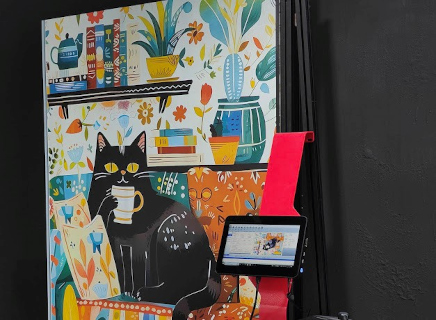
Where the quality difference comes from
“Printed directly” is a category, not a quality guarantee, so here is what sits behind ours. We print at up to 2880 dpi with a five-color UV set — CMYK plus white.
The white channel is the one worth understanding. Without it, a printer is mixing your artwork with whatever color the wall already is, which is why some direct printing is only offered on light surfaces. With a white base laid down first, a design holds its intended color on a dark green wall or a red brick one.
The other difference is width. Because the machine prints unlimited width in a single continuous pass, a large image has no join in it. Vinyl above a certain size arrives as panels, and those panels meet somewhere.
The short version
Temporary and removable, choose vinyl. Permanent and premium, choose direct printing. If you are not sure which your project is, send photos and a description and we will tell you which we would use, including when that answer is vinyl.